
Neophyte's Journal;The Poisoned Scribes
“Blossom of deception,
A velvet map of lies drawn to the gods.
Bleeding waves of Eclipse,
A symphony composed in agony
I refuse the summoning”
— Neophyte, Dusk Fragments
Blossom of Deception
POSTED March 29, 2026
Blossom of Deception
There are lies that fracture reality and there are lies that construct it.
The former are easy to identify. They contradict evidence, collapse under scrutiny, and provoke resistance.
The latter are more insidious. They are coherent, repeated, and reinforced until they form a stable architecture of perception.
These are not merely falsehoods; they are systems of orientation. They tell people what to see, how to interpret it, and what to ignore.
This is the blossom of deception: not a single lie, but a living structure that is cultivated, maintained, and harvested.
The Architecture of False Information
False information does not operate effectively in isolation. Its power lies in structure.
At its most effective, it functions as a closed epistemic loop:
- Information is curated.
- Interpretation is guided.
- Dissent is pre-framed as error or threat.
Within such a system, truth becomes secondary to coherence. A narrative does not need to be accurate; it needs to be internally consistent and emotionally resonant.
Once it achieves this, it becomes self-reinforcing.
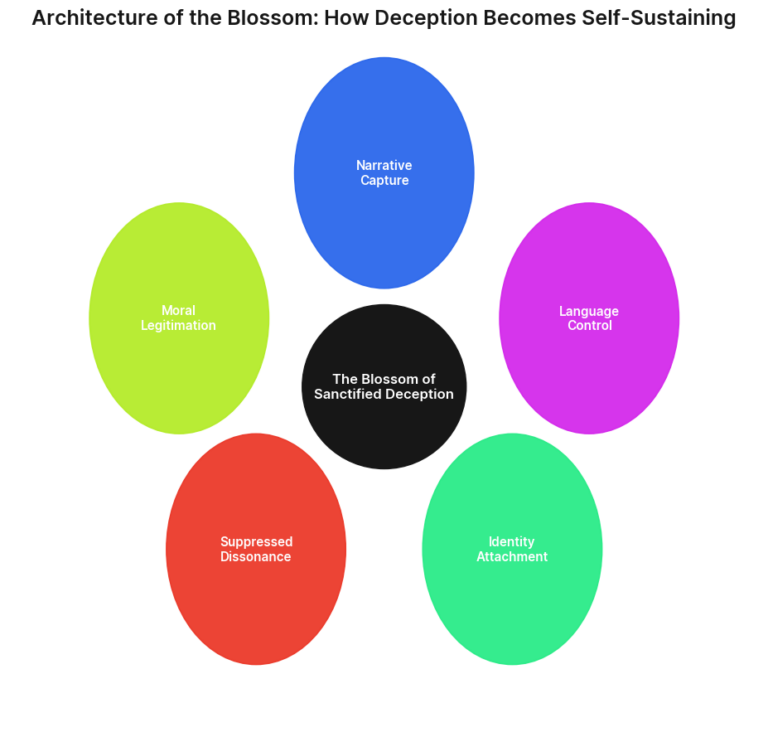
Three mechanisms sustain this architecture:
1. Narrative Framing
Every system of control begins with a story. Not necessarily a fabricated one, but a selectively constructed one.
Facts are not denied; they are arranged.
Context is not removed; it is redirected.
By controlling the frame, one controls the meaning. Events that might otherwise provoke outrage can be reframed as necessity, sacrifice, or inevitability.
Over time, the narrative becomes the lens through which reality is processed.
2. Repetition and Ritualization
Repetition transforms the unfamiliar into the unquestioned.
When a claim is repeated across institutions (e.g. education, media, leadership) it acquires a sense of inevitability.
When it is embedded in ritual (e.g. phrases, symbols, collective practices) it acquires emotional weight.
At this stage, the information is no longer evaluated. It is absorbed.
The individual no longer asks, “Is this true?”
They ask, “How does this fit within what I already believe?”
3. Controlled Dissonance
Contrary to intuition, effective systems of misinformation do not eliminate contradiction. They manage it.
Small inconsistencies are allowed, even useful. They create the illusion of complexity and authenticity. But larger contradictions are neutralized through:
- reinterpretation,
- deflection,
- or moral reframing.
This creates a state where individuals can hold conflicting ideas without resolving them. The system does not demand clarity; it demands loyalty.
The Psychology of Misguidance
To understand how deception scales, one must understand why it is accepted.
Human cognition is not optimized for truth. It is optimized for survival within a social context.
Belonging often outweighs accuracy.
Several psychological dynamics are at play:
A. Cognitive Ease
Information that is simple, familiar, and emotionally aligned is processed more easily. This ease is often mistaken for truth. Complex or dissonant information, even if accurate, feels “wrong” because it demands effort.
B. Authority Bias
When information is presented by perceived authority (whether institutional, religious, or cultural) it bypasses certain layers of skepticism. Authority signals reduce the cognitive cost of evaluation.
C. Fear and Uncertainty
In unstable environments, individuals gravitate toward narratives that offer clarity and control. Even oppressive systems can appear attractive if they provide predictability.
Deception thrives in uncertainty. It offers not truth, but relief.
From Guidance to Control
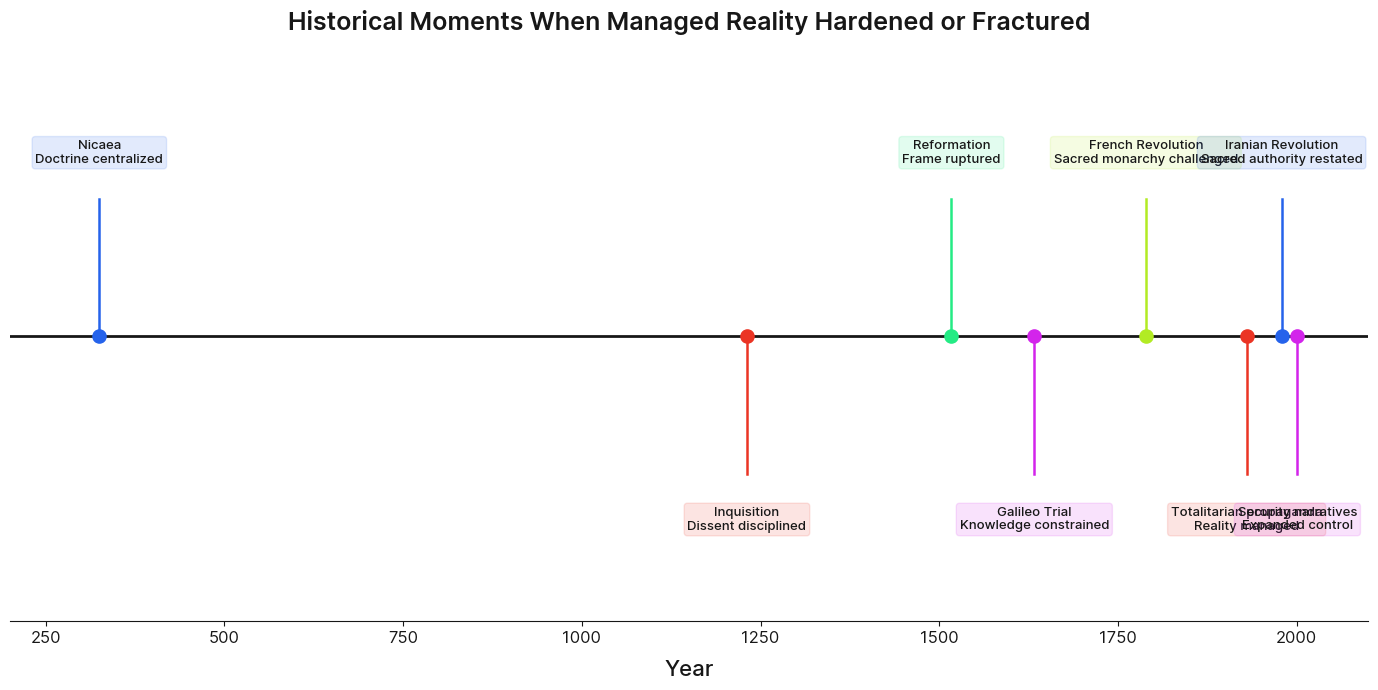
At a certain threshold, misinformation ceases to be accidental or emergent. It becomes strategic.
This is where guidance transforms into control.
Systems begin to:
- define acceptable thought,
- regulate expression,
- and punish deviation.
The goal is no longer persuasion; it is containment.
Language becomes a primary tool. Words are redefined. Concepts are narrowed or expanded to fit the narrative. Over time, the vocabulary available to describe reality is constrained.
If one cannot name a contradiction, one cannot articulate it.
If one cannot articulate it, resistance becomes impossible.
The Myth of Passive Consumption
It is tempting to view the masses as passive recipients of deception. This is incomplete.
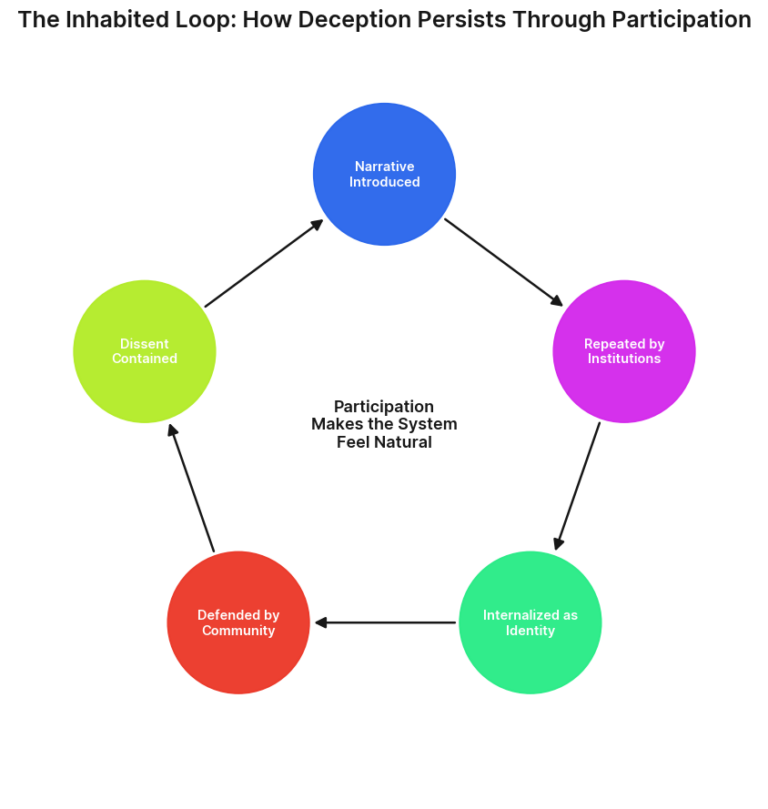
People do not merely consume narratives, but participate in them.
They repeat…
They defend…
They enforce them within their own communities.
Because belief offers:
- identity,
- stability,
- and moral positioning.
To abandon a false system is not simply to update one’s understanding. It is to risk social fracture, existential uncertainty, and loss of meaning.
Thus, individuals may actively resist correction, not because they are incapable of understanding, but because the cost of understanding is too high.
Deception persists not only through being imposed, but because it is inhabited.
The Cost of the Bloom
The blossom of deception is not without consequence.
Over time, systems built on distortion begin to exhibit structural strain:
- contradictions accumulate,
- enforcement intensifies,
- trust erodes.
At the individual level, this manifests as:
- moral fatigue,
- suppressed doubt,
- and cognitive fragmentation.
At the collective level, it produces cycles of:
- radicalization,
- conflict,
- and eventual collapse or transformation.
But collapse is not guaranteed. Some systems adapt, shedding contradictions and reconstituting themselves with new narratives.
Deception evolves.
Refusal
What, then, is the countermeasure?
Not absolute skepticism. That leads to paralysis.
Not blind belief. That leads to submission.
The alternative is disciplined inquiry:
- the willingness to hold uncertainty,
- the capacity to evaluate sources,
- and the courage to revise one’s position.
Refusal, in this context, is not rebellion for its own sake. It is the rejection of unexamined coherence.
To refuse is to interrupt the loop:
- to question the frame,
- to examine the repetition,
- to confront the dissonance.
This is not a comfortable position. It offers no immediate belonging, no simple narrative. Though, it preserves something essential: agency!
The most effective deceptions are not those that hide reality, but those that replace it.
They offer a world that feels complete, meaningful, and stable; until it begins to fracture under its own contradictions.
The blossom is beautiful.
It is structured and highly persuasive.
It feeds on perception, and it grows in the absence of scrutiny.
To see it clearly is to step outside its architecture.
Once seen, it becomes difficult to return to its comfort.
Further Reading
• The True Believer — Eric Hoffer
• Manufacturing Consent — Edward S. Herman & Noam Chomsky
• Propaganda — Edward Bernays
• Amusing Ourselves to Death — Neil Postman
• Thinking, Fast and Slow — Daniel Kahneman
• On Tyranny — Timothy Snyder
Contextual Threads
✴️ To understand how this framework manifests in fiction:
Devouring Comfort for how lies are sanctified.
From Divinity to Power for how the machinery of belief works.
- The Quite Rot for how faith permits scorching others.