
Neophyte's Journal;The Poisoned Scribes
“River of Dreams,
Thawing poison Sworn and Woven
Corpse of Weavers, Awakened Claws of the Mares
Drowned under the Maw of the Night,
Swelling Wounds ripping tides
Depths of order, Currents of chaos”
— Neophyte, Dusk Fragments
Rivers of Dream Nightmare
POSTED November 20, 2025
There are nights when something loosens. The room is the same, the body is the same, but reality feels… negotiable. You wake with the conviction that the dream was the real thing, and what you return to is the imitation.
In The Divine Poison, that feeling is not an anomaly. It is an operating system of the world.
The Veil—this living, breathing boundary between the conscious and the unseen—refuses to stay still.
It folds time.
It misfiles memory.
It is what was thought true.
Cities rearrange themselves between blinks. Names slide off the people who wear them. Books rewrite their own pages under the eclipse…
But if we step outside Arcanthia and Marenora for a moment, the unsettling question remains:
What if the Veil is not just a fantasy device, but a dramatized version of how our minds actually work?
The Brain That Dreams Universes
Every night, your brain does something extraordinary and deeply weird: it disconnects you from external input and begins to simulate reality on its own.
Neuroscience gives us a basic sketch of this process.
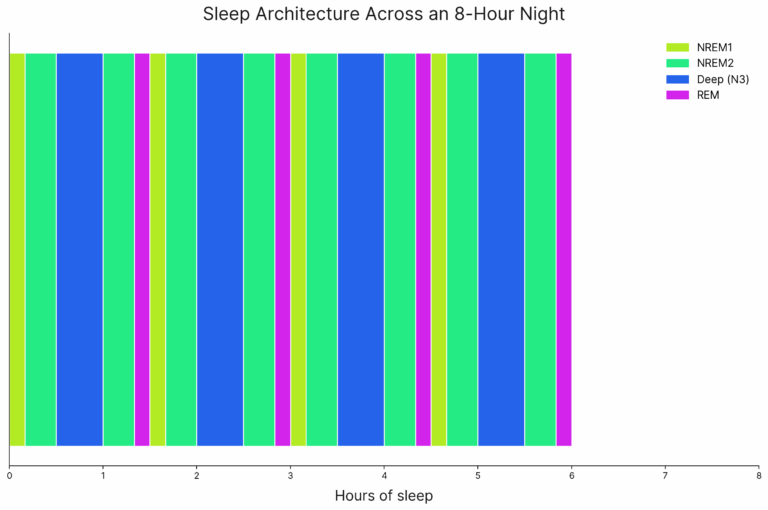
During NREM sleep, especially in the deeper stages, the brain is consolidating memories, cleaning up noise, and resetting systems. But in REM sleep—when your eyes flicker rapidly and your muscles go offline—the brain lights up in a pattern strangely similar to waking. Visual areas activate. Emotional centers fire. Logical control regions quiet down.
In that state, you are effectively trapped inside a self-generated world.
You move through landscapes, hold conversations, feel fear, lust, shame, wonder—all from electrical patterns and neurochemical storms.
The content of the dream pulls from fragments: a face from childhood, a street you saw once, a voice that never existed but feels familiar.
From that angle, you are already living under a Veil. The brain is always guessing at reality. Dreams simply show you the guess naked, without the constraint of sensory input.
The Divine Poison doesn’t invent this; it exaggerates it.
Its edges is just the brain’s own uncertainty, made cosmic.
Worshipping the Dream: Old Gods of the Night
Long before EEG machines, cultures treated dreams as messages from somewhere else.
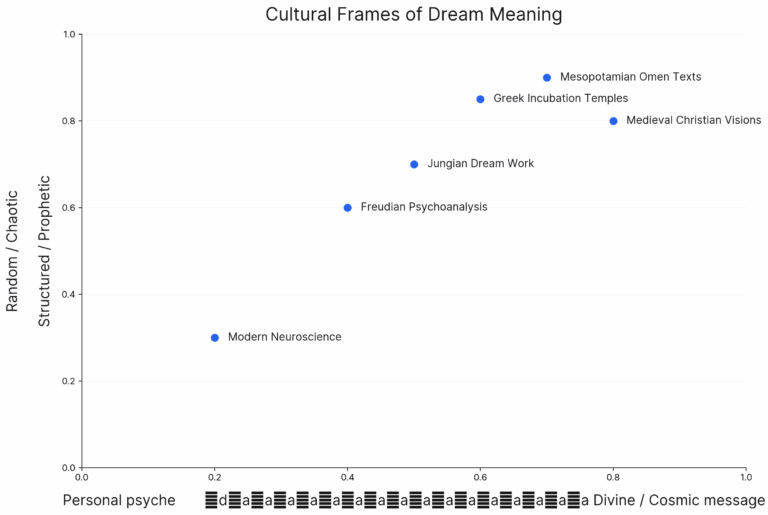
In ancient Mesopotamia, dream omens were catalogued on clay tablets. A lion in a dream might mean power or attack. Floods, collapsing houses, falling stars—none were just “random brain noise.” They were communications from gods or fates, decoded by specialists.
In ancient Greece, dream incubation was a ritual technology. Supplicants slept in the temples of Asclepius, hoping for a healing vision. The god would appear in a dream, prescribe a cure, and the waking priesthood would interpret.
Medieval Christian mystics recorded visions as revelations. Indigenous traditions across the world—First Nations, Aboriginal, Siberian, African—have seen dreams as meetings with ancestors, spirits, and non-human intelligences long before modern psychology arrived.
To them, the Veil was sacred space. To cross into dream was to step onto someone else’s territory.
The Divine Poison sits comfortably in that lineage. When characters pass through the Veil, they aren’t “just sleeping.” They’re entering a contested domain: a place where the gods, the dead, and the unconscious all claim jurisdiction.
Mythology | Name | Association / Role |
|---|---|---|
| Greco-Roman | Hypnos (Greek) / Somnus (Roman) | The primary god and personification of sleep. |
| Greco-Roman | The Oneiroi (Greek) / Somnia (Roman) | A “tribe” of one thousand spirits (sons of Hypnos) who deliver dreams to mortals. Key figures include: |
| Morpheus | The leader who appears in human forms, often as a messenger of the gods in dreams. | |
| Phobetor (Icelos) | Brings nightmares, appearing in the form of animals or monsters. | |
| Phantasos | Creates surreal, inanimate forms in dreams (rocks, water, trees). | |
| Greco-Roman | Melinoë | A chthonic nymph/goddess associated with nightmares and madness. |
| Mesopotamian | Mamu (female) and Sisig (male) | Deities of dreams and divination, seen as messengers of the sun god Utu/Shamash. |
| Native American (Ojibwe) | Asibikaashi | The Spider-Woman figure associated with protecting children from bad dreams using a charm (the dreamcatcher). |
| Lithuanian | Breksta | The goddess of twilight and dreams who provides protection between sunset and sunrise. |
| Celtic | Caer Ibormeith | A figure in Irish mythology associated with dreams and love. |
| Egyptian | Tutu (Tithoes) | A minor god invoked for protection during sleep and dreams. |
| Yoruba | Olorun | Sometimes mentioned as a god of sleep in certain African traditions. |
| Folklore (Western) | The Sandman | A classic folkloric character who brings sleep and pleasant dreams by sprinkling sand. |
Jung’s Archetypes: Who Lives On the Other Side
Carl Jung took dreams personally—but not just individually. For him, dreams were doorways into something deeper than your private biography.
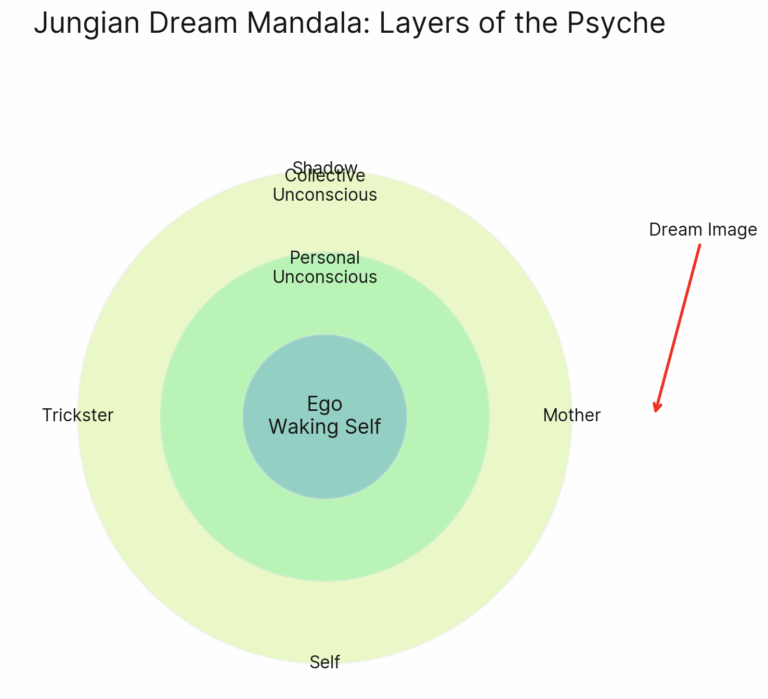
He proposed that beneath the personal unconscious (your specific repressed memories, embarrassments, wounds) lay the collective unconscious: a shared reservoir of images and patterns that all humans tap into.
These patterns are archetypes. They show up in myths, religions, folktales, and of course, dreams.
The Mother: nurturing, devouring, sheltering, smothering.
The Shadow: everything you are but refuse to admit—your hunger, rage, cruelty, power.
The Trickster: boundary-breaker, liar, liberator.
The Self: the deeper totality that wants you to become whole, even if it has to drag you there.
In The Divine Poison, the Veil behaves exactly like a Jungian threshold. Step through, and you don’t just meet monsters—you meet structures of yourself. The Neophyte, the Watcher in the dark, the eclipsed horizon, the blood-rain: all of them can be read as archetypal faces wearing the local mythology as a mask.
From a Jungian angle, the Veil is less a wall between real and unreal, and more a membrane between conscious and archetypal. Dreams in that universe are not random; they are negotiations. Contracts. Sometimes indictments.
The Fragile Geometry of Reality
When reality can be edited—by gods, by dreams, by memory—meaning becomes a survival tool.
In The Divine Poison, those who cross the Veil are not casual travelers. They are test subjects in a cosmic experiment.
If the city you walk through at night is not the same city you find in the morning, what anchors you? If a name changes when you glance away, does that person still exist in the same way? If the Neophyte’s words rewrite themselves, was any version of them ever “final”?
This is not so distant from what cognitive science tells us. Your brain does not passively receive reality; it actively predicts it. It uses prior experiences to guess what’s out there, then corrects based on incoming data. Perception is a controlled hallucination that is constantly being nudged toward consensus.
In dreams, we see what happens when that control relaxes. The hallucination runs free.
That’s why, in both science and story, dream has teeth. It can reshape what you think is possible. It can weld together experiences that never met in waking life. It can show you a version of yourself that feels more honest than whatever you perform during the day.
In that sense, the Veil is harshly fair. It does not care which side you call “real.” It only enforces one rule: Whatever you believe in strongly enough will bite back.
Perhaps this is why some Seekers whisper: “The path to dream is walked awakened.” It is a call to heightened awareness, a recognition that the boundaries are fluid and the responsibility immense.
Contextual Threads
✴️ To understand how this framework manifests in fiction:
Read The Reign of Eclipse for how celestial phenomena become theology.