
Neophyte's Journal;The Poisoned Scribes
“Bent before the deathly messenger,
drunk on the fragrance of blood.
Dissent festers in jaded wounds,
moths offered to the divine flame.
Liturgies of Obedience”
— Neophyte, Dusk Fragments
Devouring Comfort
POSTED February 26, 2026
The Devouring Comfort
There is a peculiar sanctity granted to certain lies. Not because they are true, nor because they are beautiful, but because they are useful.
They comfort.
They stabilize.
They bind communities together under a shared canopy of meaning. And when a lie is sufficiently useful, it ceases to be called a lie at all:
It becomes doctrine.
It manifests itself as destiny.
It turns sacred.
Human beings are not merely meaning-seeking creatures; we are meaning-defending ones.
Once a narrative provides existential coherence (e.g. explaining suffering, justifying hierarchy, promising redemption) it embeds itself into identity.
To question it is not simply to dispute a claim; it is to threaten belonging, morality, and the structure of hope itself.
Thus, belief becomes less about truth and more about preservation.
This is where the devouring begins.
The Psychology of Sanctified Falsehood
Belief systems endure not because they are empirically robust but because they are psychologically adaptive.
Cognitive Dissonance Theory (Leon Festinger, 1957) explains that when individuals encounter contradictions to deeply held convictions, they do not typically abandon the conviction.
Instead, they reinterpret, rationalize, or compartmentalize.
The mind bends to protect the structure that provides it comfort.
Sacralized ideologies exploit this architecture. When a claim is framed as divinely ordained, questioning it is framed not as intellectual inquiry but as moral transgression.
Doubt becomes sin. Skepticism becomes betrayal. The epistemic barrier hardens.
Within such systems, strategic deception can become permissible—sometimes even virtuous—if it serves the higher mission.
The logic is chillingly efficient: if the cause is sacred, and the end is righteous, then any distortion of truth becomes a tool of preservation.
The lie is no longer a moral failing; it is an instrument of faith!
This phenomenon is not confined to one tradition, era, or geography. It is structural.
Whenever a system defines itself as absolute, it inevitably generates mechanisms to shield itself from critique. These mechanisms can include reinterpretation, selective disclosure, narrative manipulation, and at times, overt coercion.
The psychological reward remains the same: safety within certainty.
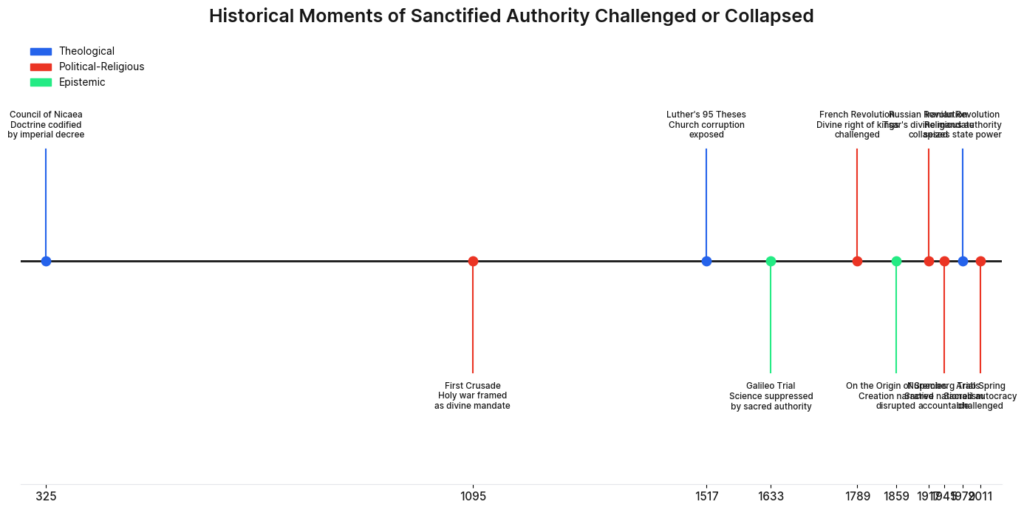
The Concept of Taghya: A Sacred Authority
Across traditions, there exists a recurring archetype: the figure or structure that claims divine sanction while consolidating power.
In some theological and philosophical discourses, the notion of taghya—loosely interpreted as transgressive or illegitimate authority that demands submission and deception—captures this dynamic.
It refers to that which exceeds bounds, that which elevates itself to divine status and demands unquestioned allegiance.
Conceptually, taghya is not about a specific creed. It is about the mutation of authority into sanctified domination. It is the transformation of political or institutional ambition into metaphysical inevitability.
When authority cloaks itself in transcendence, it becomes insulated from ordinary moral scrutiny.
- Policies are prophecies.
- Leaders are vessels.
- Agendas are destiny.
The system feeds on devotion while portraying dissent as existential threat.
Here lies the philosophical paradox: the very traditions that warn against idolatry can become engines of it.
The idol is no longer a statue but a structure, a hierarchy, a dogma, a narrative that claims divine necessity.
In such environments, deception can be framed as strategic patience. Silence can be framed as wisdom. Manipulation can be framed as stewardship.
The sacred canopy shelters both faith and fraud.
The Devouring Mechanism: How Belief Consumes the Believer
Belief, when unexamined, has a metabolic quality.
It consumes cognitive resources, emotional energy, and moral autonomy.
The individual becomes a carrier of the system’s imperatives.
Three mechanisms are particularly potent:
- Moral Inversion
Actions that would ordinarily be condemned become justified if performed in service of the sacred. The harm inflicted externally is reframed as purification. The internal discomfort is reframed as sacrifice. - Identity Fusion
The self merges with the ideology. An attack on doctrine feels like an attack on the body. In such states, individuals may defend abstract narratives with visceral intensity. - Apocalyptic Framing
The world is divided into forces of light and darkness. Urgency overrides deliberation. Complexity collapses into binaries. Under apocalyptic logic, deception becomes tactical warfare.
Over time, the believer is not merely guided by the system; they are metabolized by it. They become an instrument in the preservation of structures that may, paradoxically, erode their own agency.
The tragedy is subtle. The comfort that belief provides—certainty, belonging, moral clarity—gradually demands increasing loyalty.
The price of doubt rises.
The cost of departure becomes exile, both social and psychological.
Thus, lie remains intact not because it is convincing, but because leaving it would fracture identity.
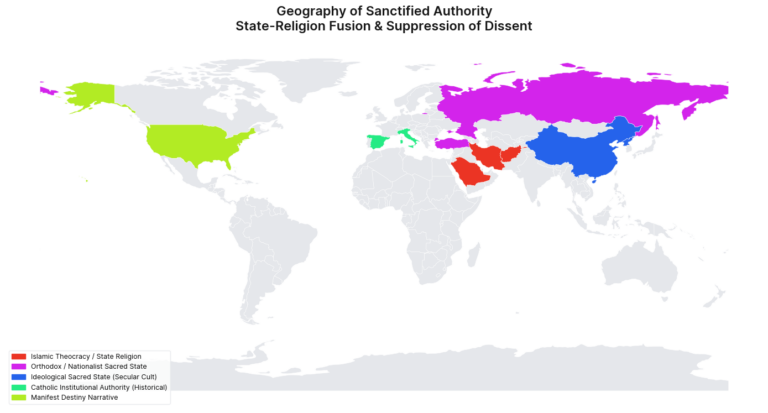
Feeding the Dying Gods
In myth, dying gods demand sacrifice to sustain their waning power.
Symbolically, these gods represent systems that have lost moral vitality but retain institutional inertia.
They persist not through truth but through repetition.
When narratives lose explanatory power, they often intensify.
- The rhetoric becomes sharper.
- The boundaries become stricter.
- The penalties for dissent increase.
The system must consume more devotion to maintain its façade of inevitability.
Believers, seeking comfort, offer themselves willingly.
- They defend contradictions.
- They reinterpret failures as tests.
- They sanctify suffering as proof of righteousness.
The dynamic is circular. The system requires belief to survive; belief requires the system to validate identity. Each feeds the other.
But dying gods are not sustained by truth. They are sustained by fear and by the human aversion to uncertainty.
In a chaotic world, certainty—even oppressive—can feel preferable to ambiguity.
The Ethics of Exposure
To critique sanctified lies is not to wage war on faith itself. Faith, at its best, is an exploration of transcendence and moral aspiration.
The danger arises when faith becomes fused with institutional self-preservation.
The ethical challenge is therefore precise:
How does one interrogate systems of sanctified deception without descending into nihilism or persecution?
The answer lies in epistemic humility and moral consistency.
No claim should be immune to scrutiny.
No authority should be beyond accountability.
If a system requires deception to survive, its moral legitimacy is already compromised.
Exposure is not violence; it is illumination. But illumination carries risk.
History has demonstrated that those who challenge sanctified power structures often encounter hostility. Not because they are wrong, but because they destabilize comfort.
Thus, the critique must remain conceptual rather than inflammatory, analytical rather than incendiary.
The aim is not to desecrate belief but to disentangle truth from utility.
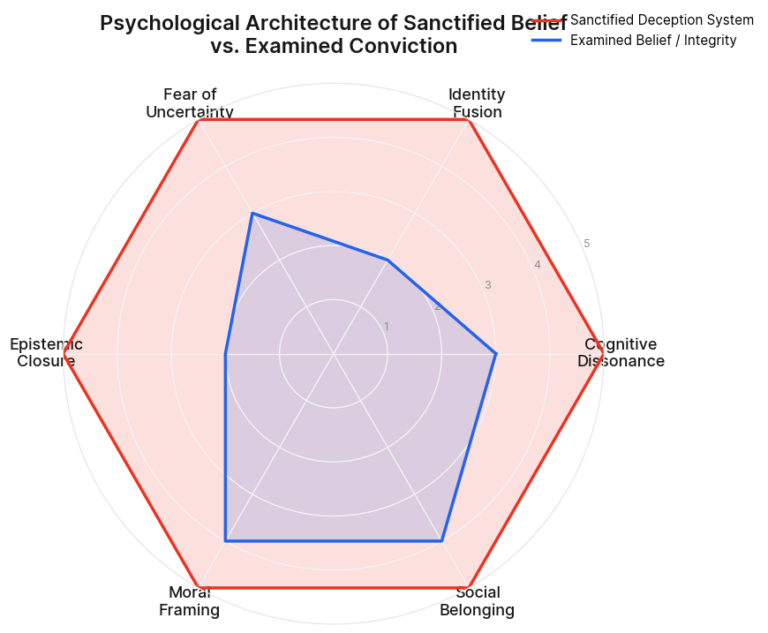
Discomfort Over Devouring
The devouring comfort of belief offers warmth. It offers clarity. It offers community. But when comfort becomes conditional upon silence, when belonging requires distortion, and when sanctity demands deception, something corrosive has taken root.
The choice before any individual is not between belief and disbelief. It is between comfort and integrity. Between inherited certainty and examined conviction.
Systems that rely on strategic deception will eventually reveal their fragility.
Truth has a destabilizing patience…It waits…It accumulates…It resists containment.
To step outside sanctified lies is not to abandon meaning. It is to reclaim it from structures that would consume it.
And perhaps the most subversive act in any age is not rebellion, but refusal to be fed to dying gods, to sanctify distortion, or to surrender one’s conscience for the illusion of certainty.
Further Reading
• The Righteous Mind — Jonathan Haidt
• The Demon-Haunted World — Carl Sagan
• The True Believer — Eric Hoffer
• Escape from Freedom — Erich Fromm
• Thinking, Fast and Slow — Daniel Kahneman
Contextual Threads
✴️ To understand how this framework manifests in fiction:
The March of Faith for how faith is used as a machine.
From Divinity to Power for how the machinery of belief works.
- The Quite Rot for how faith permits scorching others.