
Neophyte's Journal;The Poisoned Scribes
“The light demanded blood,
Silenced our thoughts in its might
Basked in dark flames…
Flares of a deathly frame
A guiding darkness of an inherent weapon.
Burning innocence, wounding hearts”
— Neophyte, Dawn Fragments
The Quiet Rot
POSTED January 22, 2026
The Seduction of Certainty
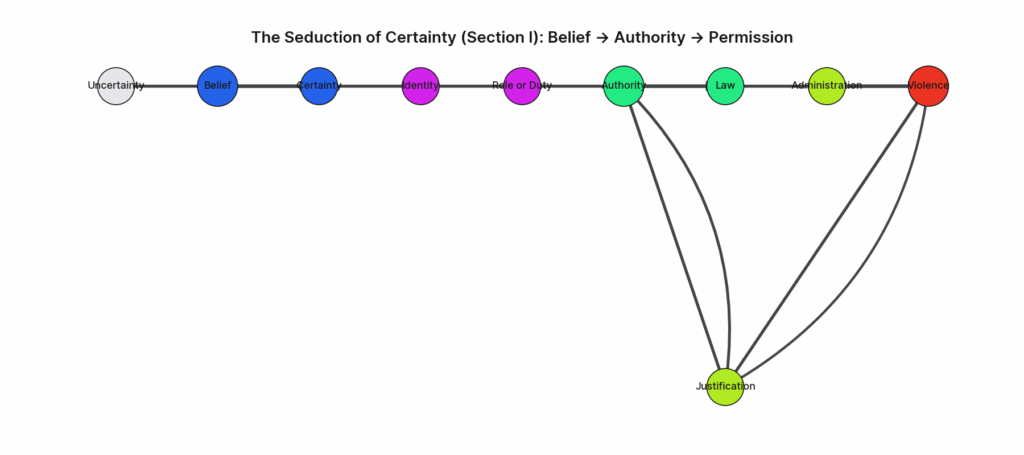
Belief rarely announces itself as a weapon. It enters as solace, structure, and meaning. In uncertain times, belief offers the architecture of order: answers where none exist, purpose where chaos reigns. This is its first seduction — certainty without evidence, belonging without understanding, obedience without inquiry.
The danger of belief does not lie in the comfort it ‘provides’, but that it solidifies. Once belief is framed as sacred, it becomes insulated from correction. When fused with identity, doubt becomes betrayal, and as it is codified into law, violence becomes administration.
Richard Dawkins called this the God Delusion — not because gods are uniquely dangerous, but because belief exempted from scrutiny is immune to moral evolution. The delusion is not faith itself; it is the conviction that faith must be obeyed regardless of consequence.
Belief, at its best, is a story we tell ourselves to survive uncertainty.
At its worst, it becomes a system that outsources morality and replaces conscience with command.
The danger of belief is not that it is false (which it is!).
It is that it is total.
Belief framed as sacred, ceases to be questioned;
as duty, ceases to be resisted.
as truth, ceases to be human.
This is the moment where belief rots—both in doctrine, and in behavior.
From Doctrine to Behavior
From Doctrine to Behavior
The transition from belief to brutality is rarely abrupt. It is gradual, incremental, and often invisible to those inside it.
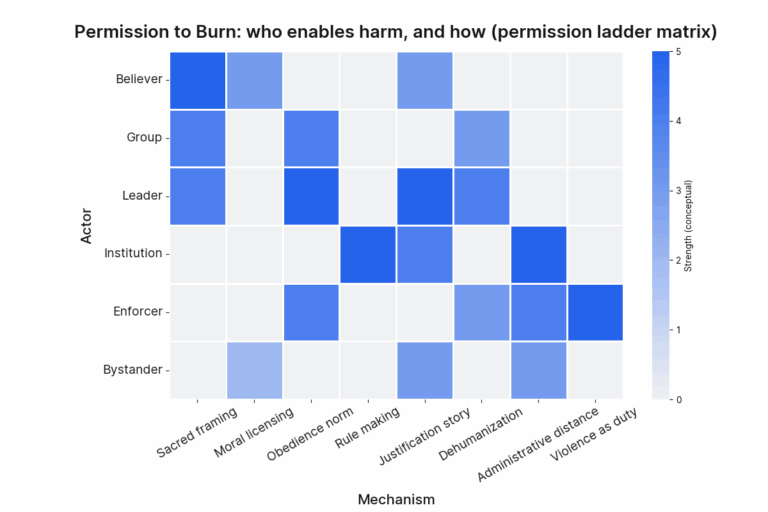
Ordinary people commit extraordinary cruelty when roles, authority, and justification align (The Lucifer Effect). Religion, at its most rigid, provides all three:
- Roles: believer, infidel, apostate, pure, impure
- Authority: divine command, scripture, clerical class
- Justification: eternal reward, cosmic necessity, sacred duty
Once harm is framed as obedience, cruelty is now a virtue.
This is how violence is normalized without malice.
The hand that strikes, believes that it heals. The blade that cuts, believes that it purifies.
Religions behave like self-replicating ideas—memes that prioritize survival over truth. But what is often missed in The God Delusion is not the critique of deities, but also the critique of systems that sanctify obedience.
A belief that cannot be questioned must be enforced.
A belief that must be enforced must also be defended.
A belief that is now defended will demand violence.
The violence does not begin with the sword.
It begins with permission
The Economics of Luciferian Faith
In March of Faith, I explored how holy war emerges when belief meets material incentive — land, power, hierarchy, legacy. The words change: crusade, jihad, purification, defense of the sacred. But the mechanics remain.
Sanctity is expensive. It requires blood to remain believable.
A ritualized violence, repeatable and righteous. This is now a tradition, invisible and lasting.
At this stage, belief no longer merely permits violence — it demands it to maintain coherence. A faith that does not punish dissent eventually collapses. It punishes. Not because it is just cruel, but because it is also fragile.
Philip Zimbardo’s Lucifer Effect demonstrates how ordinary people commit extraordinary harm when placed in systems that:
- Legitimize cruelty
- Diffuse responsibility
- Provide moral justification
Religion, when weaponized, offers all three:
- Authority without accountability
- Suffering reframed as virtue
- Violence reframed as purification
This is not unique to any one faith.
But history shows that when belief is absolute and identity-bound, brutality becomes not just acceptable—but righteous.
The crusader, the jihadi, the inquisitor, the martyr—
all believe they are doing good.
This is the most dangerous form of evil: the one that feels holy.
Permission to Burn
The most corrosive effect of dogmatic belief is not war, but moral outsourcing. A quiet rot of everyday morality and decency.
When individuals no longer own their ethics, they defer them.
- To scripture instead of empathy
- To clergy instead of conscience
- To doctrine instead of responsibility
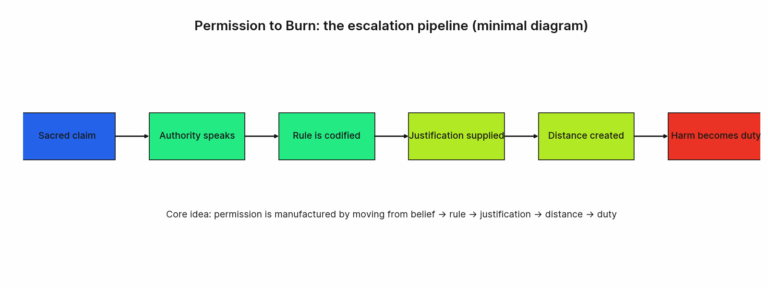
At this point, cruelty no longer feels like cruelty. It feels like duty. Silence becomes righteousness. Submission becomes goodness. Violence becomes obedience in motion.
This is not unique to any one religion. But some structures — especially those that fuse law, identity, and divinity — accelerate the decay. Where belief governs behavior from birth, where exit is punished, and where doubt is framed as treason, the rot is systemic.
The problem is not the belief in a deity itself.
The problem is a belief that requires victims and blinds thought.
Once violence is framed as sacred, it becomes normalized:
- Children become soldiers
- Women become symbols
- Death becomes currency
- Doubt becomes treason
The language shifts first.
Then the laws.
Then the pile of bodies.
This is why holy wars do not end when enemies are defeated—
they end only when belief fractures.
What do we owe one another, when no god is watching?
We have not outgrown the religions that weave threads of rot.
We have only replaced the old gods with new gods, flags, markets, ideologies, and algorithms.
The structure remains:
- Infallible truth
- Sacred narrative
- Moral exemption
- Permitted harm
The Divine Poison surrounds this thought process that is bound to no limit. When piety shows its true self, and laws are corrupted by design.
Further Reading
• Dawkins – The God Delusion
• Zimbardo – The Lucifer Effect
• Arendt – Eichmann in Jerusalem
• Girard – Violence and the Sacred
• Hitchens – God Is Not Great
• Hitchens – The Missionary Position
• Hedges – War Is a Force That Gives Us Meaning
• Harris – The End of Faith
Contextual Threads
✴️ To understand how this framework manifests in fiction:
The March of Faith for how faith is used as a machine..
- From Divinity to Power for how the machinery of belief works.