
Neophyte's Journal;The Poisoned Scribes
“Cathedral of Lies,
Vomiting Grace Sworn and Hollow
Carcass of Zealots, Festering Truths Wounded and Broken
Derafsh of Holy Crowns,
Jagged Shards stained by Blood
Bound in Iron, Drowned in Light”
— Neophyte, Dusk Fragments
The MarchOf Faith
Holy Wars Hollow Crowns Designer
POSTED December 20, 2025
When Faith Meets Steel
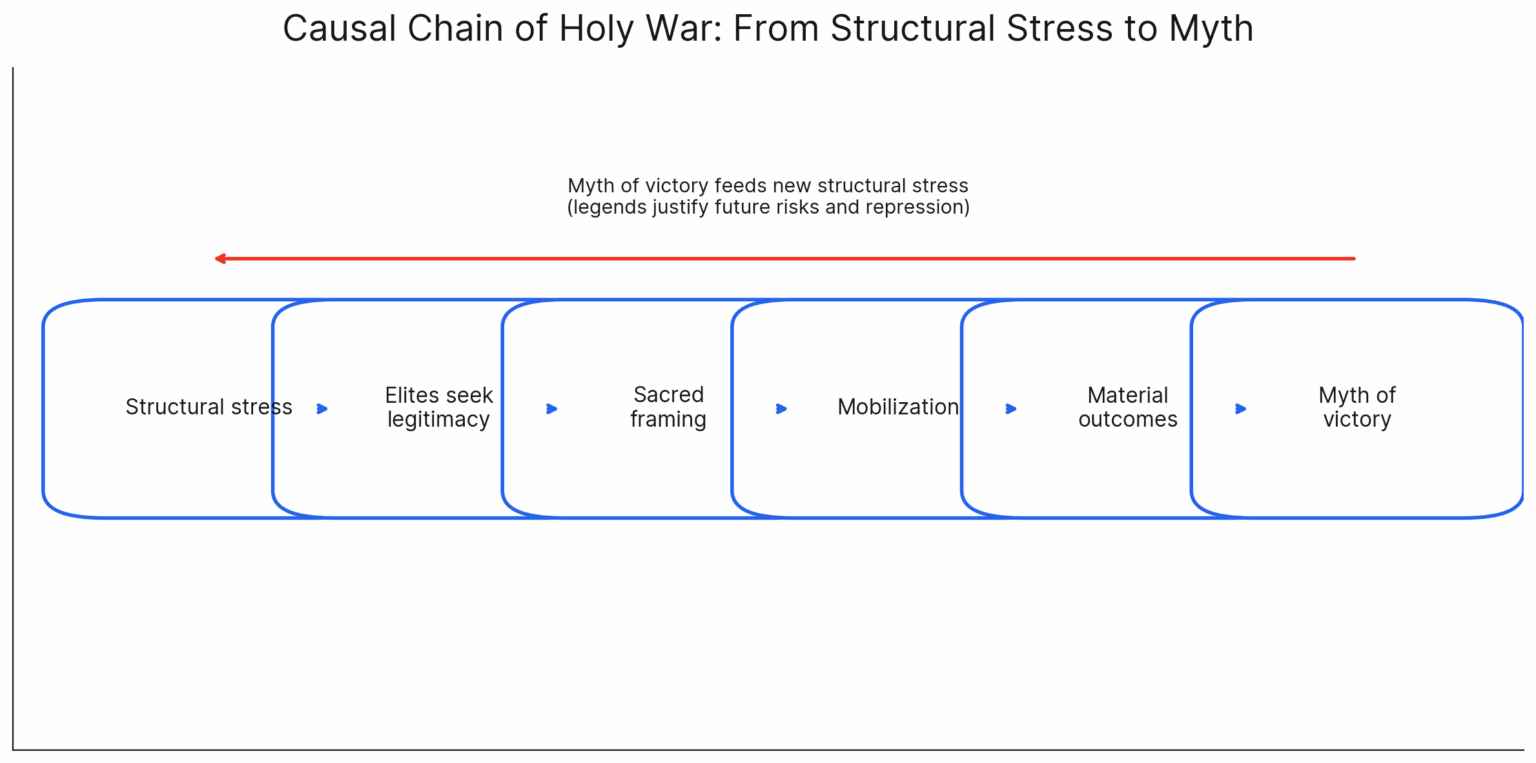
Holy wars do not start with a verse; they start with a vacuum. A failing order needs legitimacy; a rising faction needs a banner. Religion provides both—a grammar for grievance, a cosmology for courage, an afterlife for risk. When conduits of power run dry, elites pump the sacred into the pipes. The result looks like piety, but it tastes like logistics.
Every age that “discovers” holy war is already sitting on a pile of problems it cannot solve with tax reforms and polite decrees. Sanctity arrives as a solvent and a glue at once: dissolving old restraints while binding scattered energies into a single direction.
The Conditions of a Holy War
Behind the rhetoric of chosenness and destiny, historians keep finding the same structural fingerprints. Sanctified conflicts tend to emerge where you see:
Central authority in crisis or consolidation. A king facing revolts at the periphery, or a new dynasty trying to prove it isn’t just a lucky coup, both reach instinctively for the sacred. When the crown is wobbly, the halo gets brighter.
Intense material competition. Land, trade routes, tribute streams, control of shrines and relics—these are the arteries of real power. “Defending the faith” often overlaps cleanly with defending customs revenues and caravan roads.
Symbolic competition over purity and authenticity. True faith versus corrupted rivals, orthodoxy versus heresy, insiders versus polluting strangers. When you see polemics about who has “sold out” the tradition, you are already in the runway lights of sacralized conflict.
Effective communication networks. Pulpits and minbars, monastic scriptoria, merchant gossip, printing presses, cheap pamphlets, satellite TV, Telegram channels, deepfake sermons: holy war needs distribution. It is not enough to have a doctrine; you need a microphone.
Robust promise structures. Absolution, booty, tax breaks, status, a new social identity, an eternal reward. The campaign is packaged as a miracle of accounting: losses now, infinite returns later. That math only works in an economy where the afterlife is part of the balance sheet.
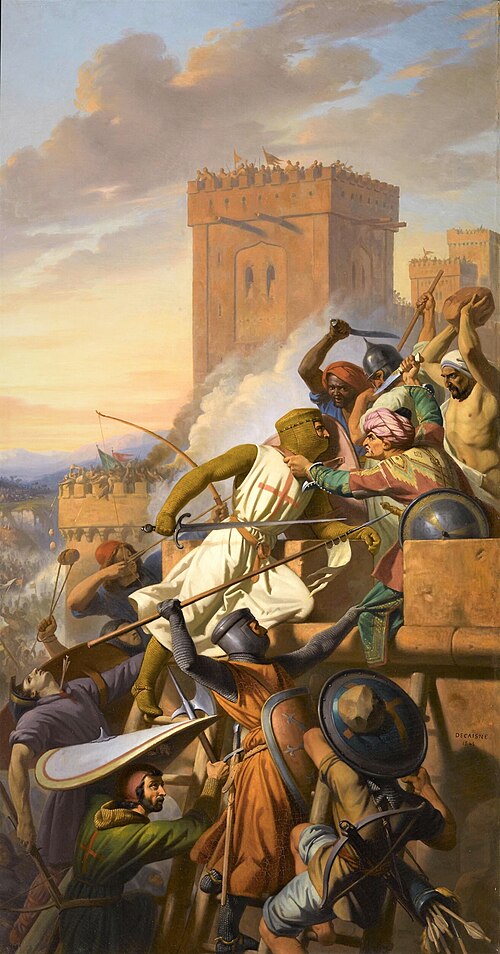
The First Crusade, for instance, was a marvel of coordination before it was ever framed as a miracle. Religious rhetoric translated grueling logistics into spiritual investments. The call to “liberate” Jerusalem turned a complex operation of migration, conquest, and plunder into a pilgrimage with a kill-count.
Jihad, Crusade, and Contested Words
Terms like “jihad” and “crusade” are not static objects; they are moving targets in the crossfire of history.
Jihad, in classical Islamic discourses, spans: Inner struggle against vice. Legal and intellectual struggle to articulate God’s will. Collective defense under attack. In some legal schools, offensive expansion under strict conditions and centralized authority.
“Crusade” ranges from penitential pilgrimage with arms to fully institutionalized, bureaucratic war-machines with their own tax streams and propaganda offices.
Concepts expand when they encounter empire; they narrow when they encounter reform. An imperial project prefers vague, elastic words that can absorb new frontiers. Reformers—legalists, theologians, activists—try to nail the word back down, to say “this is what it can and cannot mean.”
Scripture is a repository of possibilities. Jurisprudence is a gatekeeper of probabilities. Politics decides the actualities.
So when someone says “our war is true jihad” or “this is a new crusade,” you are not only hearing theology; you are hearing a bid to control that sliding scale between possibility and actuality.
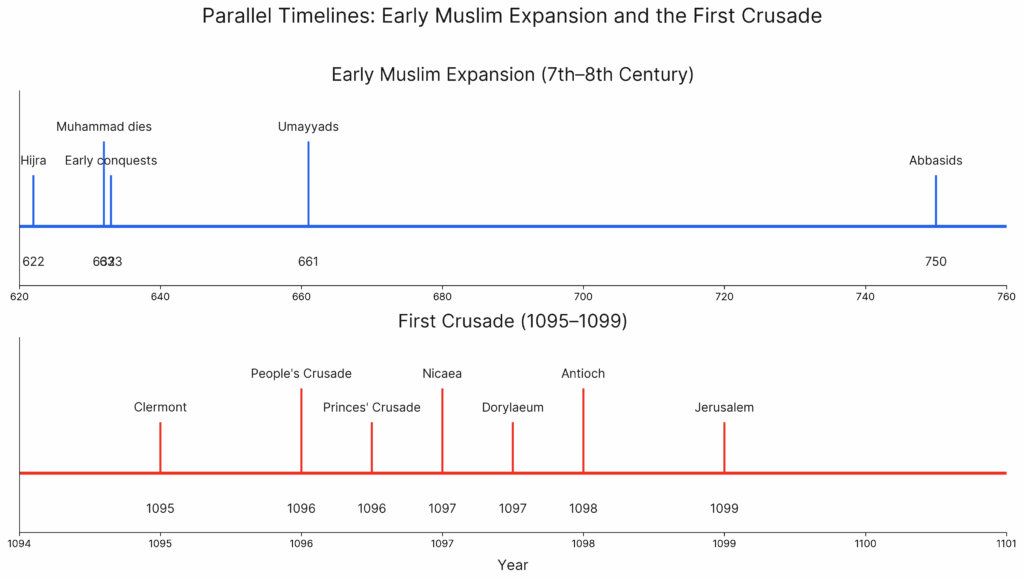
| Axis | Early Muslim Expansion (7th–8th c.) | First Crusade (1095–1099) |
|---|---|---|
| Approx. start phase | 630s–640s (after Muhammad; Rashidun Caliphate) | 1095 (Council of Clermont) → 1096–1099 (campaign) |
| Core political context | Collapse/weakening of Byzantine and Sasanian empires | Fragmented Latin Christendom; Byzantine crisis under Alexios I |
| Structural stress | Exhausting Byzantine–Sasanian wars; plague; fiscal strain | Seljuk advances, loss of Asia Minor, internal European violence |
| Main actors | Rashidun / early Umayyad caliphs and tribal armies | Papacy, Western European princes, Byzantine Empire, Latin knights |
| Framing by elites | Expansion of dār al‑islām; unity under a new revelation | “Liberation” of Holy Sepulchre; aid to Byzantium; penitential war |
| Sacred vocabulary | Jihad (with multiple layers: defense, expansion, order-making) | Crusade (not yet fixed term, but armed pilgrimage, taking the Cross) |
| Material goals | Tribute, land, control of routes/cities (Damascus, Jerusalem) | Fiefs, plunder, titles, control of Levantine ports and cities |
| Religious goals | Spread of the new faith; ordering of community and law | Access/safety of pilgrimage; defense of Eastern Christians |
| Legitimacy problem | New ruling elites need authority over diverse populations | Papacy vs emperors/kings; knights with surplus violence at home |
| Mobilization tools | Tribal networks, stipends (ʿaṭāʾ), promise of booty/status | Preaching tours, indulgences, vows, social pressure, relic cults |
| Key logistical reality | Light, fast-moving armies; use of existing imperial infrastructures | Long-distance march, supply lines from Europe, shipping, financing |
| Outcome (short term) | Rapid empire from Iberia to Central Asia | Conquest of key cities (Antioch, Jerusalem); Latin states created |
| Outcome (long term) | Institutionalized caliphates; administrative and legal systems | Repeated crusading cycles; entrenched Latin/Eastern antagonisms |
| Myth-building | Age of the “Rightly Guided” and just conquest | “Miracles” of victory; martyrdom narratives; chosen-warrior myth |
| Feedback into new conflicts | Conquest narratives inform later claims to legitimacy and reform | Crusading ideal reused for internal wars, heresies, and politics |
The Economics of Sanctity
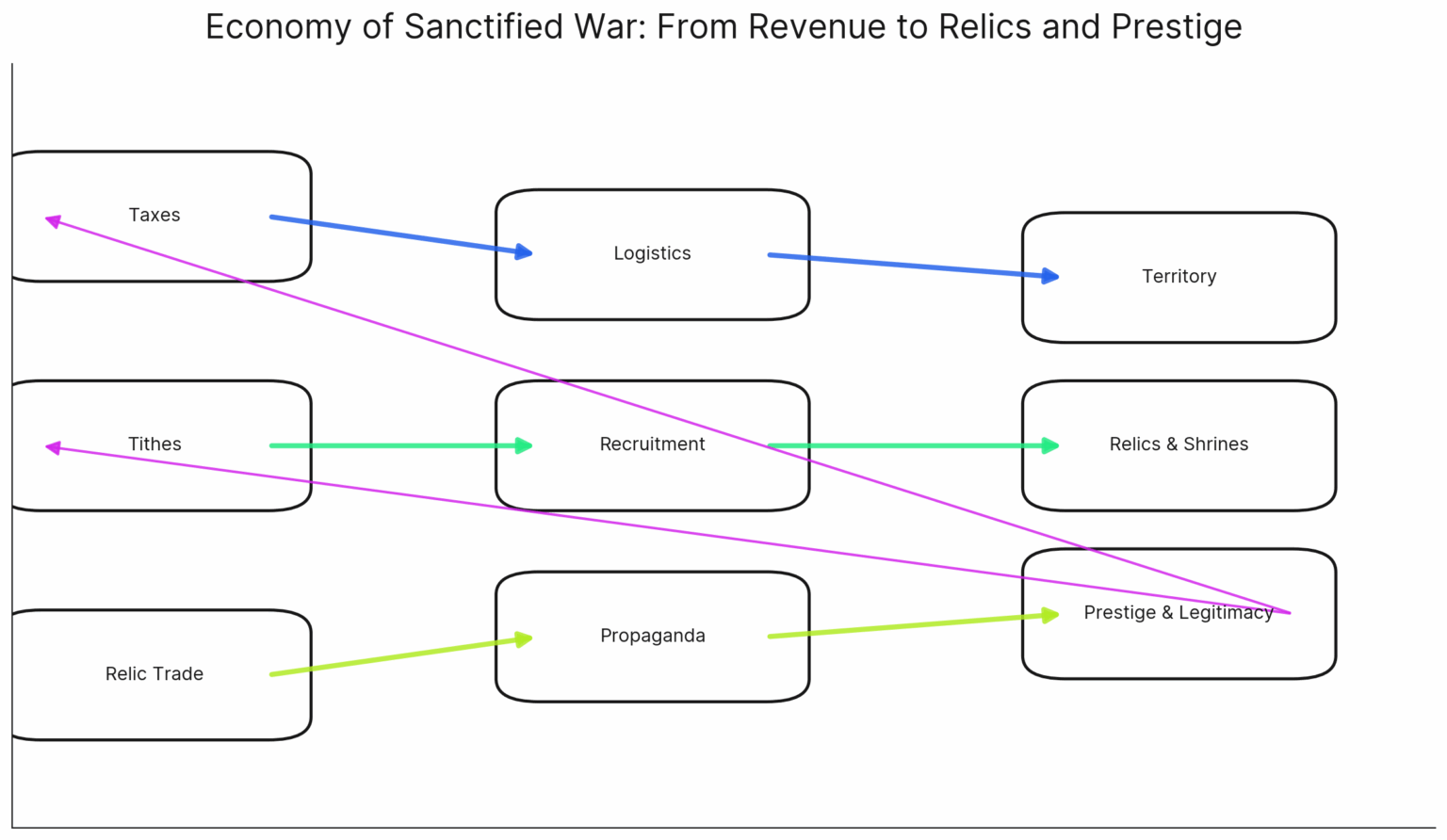
Sanctity is not just an idea—it’s an asset class.
Control a shrine, and you control flows of people and wealth. Control canon, and you control the curriculum of imaginations. Control relics, and you control the emotive economy of grief and hope.
Periods of religious “fervor” often coincide with upgrades in state capacity: better tax records, more standardized laws, fortified borders, professionalized clergy. Spiritual centralization rides on the back of administrative centralization.
When pilgrims converge on a holy city, they don’t just bring prayers. They bring offerings, purchases, contracts, marriages, guild ties. Holy sites become clearinghouses of both grace and credit. Any war that rearranges who owns those sites is also rearranging who sits at the top of that economic pyramid.
In that sense, a holy war is frequently a brutal kind of portfolio rebalancing: relics and lands are seized, clerical hierarchies are reorganized, incomes are rerouted. The language on the banners is about heaven; the ledgers are very earthly.
The Violence of Purity
The language of purity is a solvent. It erases nuance, intermediate categories, and bargaining positions.
Once you divide the world into the absolutely clean and the absolutely contaminated, compromise looks like complicity. You don’t negotiate with a disease; you eradicate it.
Judith Shklar argued that cruelty is the worst political vice. Purity rebrands cruelty as duty. Torture becomes an emergency surgery on the body of the community. Massacres become “cleansing.” The rhetorical move is chillingly simple: the enemy is not just wrong; the enemy is pollution.
When the enemy is described as contagion, extermination appears hygienic.
This is why “holy” violence is not merely destructive; it is purifying, and therefore self-justifying. Once a movement sees itself as the surgeon of history, there is no obvious internal limit to what it is willing to cut away.
Further Reading
Raymond Ibrahim — Sword and Scimitar: Fourteen Centuries of War Between Islam and the West
William Cavanaugh — The Myth of Religious Violence
Mark Juergensmeyer — Terror in the Mind of God
Karen Armstrong — Holy War; Fields of Blood
Jonathan Riley-Smith — The First Crusade and the Idea of Crusading
Christopher Tyerman — God’s War
Marshall Hodgson — The Venture of Islam
Fred Donner — Muhammad and the Believers
Ibn Khaldun — The Muqaddimah (asabiyya and state power)
Peter Turchin — Ultrasociety
Amartya Sen — Identity and Violence
Saba Mahmood — Politics of Piety
René Girard — Violence and the Sacred
Charles Kimball — When Religion Becomes Evil
Contextual Threads
✴️ To understand how this framework manifests in fiction:
Read The Reign of Eclipse for how celestial phenomena become theology.
- From Divinity to Power for how the machinery of belief works.