
Neophyte's Journal;The Poisoned Scribes
“A darkness wakes inside the silk,
Devours the hope it cannot name.
The eyes that see beyond the veil
are the first to burn
and the last to be forgotten”
— Neophyte, Eclipsed Fragments
The Last Heretic
POSTED June 2, 2026
The Thread That Should Not Have Been Pulled
In Threaded Shadow-Silk, we mapped the loom: fate, forge, fervor, faith, fount, and frame.
Six forces that weave reality into something that feels inevitable. The post ended with a quiet provocation.
To question fate is to reclaim choice.
But it did not ask what happens next.
What happens to the one who actually does it?
The heretic is not a rebel by design. They do not begin with a manifesto or a death wish.
They begin with a question — a small, private fracture in the frame — and they cannot stop asking it.
This is the post about that person.
Not about heresy as doctrine. Not about martyrdom as symbol.
About the individual who pulls the thread and what the loom does in return.
What emerges is not truth.
It is coherence… Or Decoherence.
The Accidental Clarity
Heresy rarely starts as a choice.
Leon Festinger’s research on cognitive dissonance tells us that the human mind is built to protect its beliefs, not interrogate them.
When a contradiction surfaces, the default is rationalization = absorption, not revision.
Most people never become heretics because the mind is astonishingly good at managing its own contradictions.
But some minds cannot.
Whether by temperament, trauma, or the sheer accumulation of evidence that refuses to resolve, certain individuals reach a threshold where the inherited frame stops holding.
The question surfaces not as rebellion but as a cognitive emergency: this does not add up.
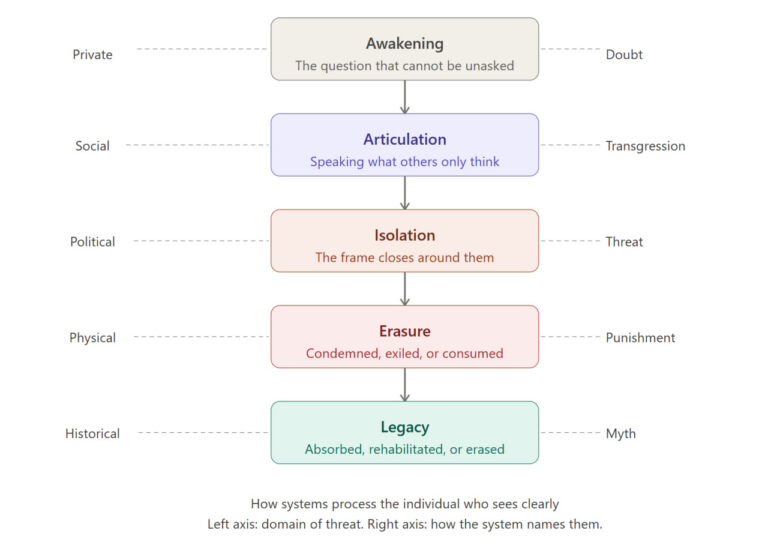
This is the awakening and it is rarely welcome.
It carries no triumph.
It arrives as vertigo.
The frame that once organized reality [ the fount that made authority legible, the fervor that made belonging feel earned ] starts to look like architecture.
Beautiful.
Constructed.
Consigned.
Contingent.
In The Divine Poison, the Veil operates this way. It does not announce its own artificiality.
It simply… shifts. And the one who notices the shift cannot un-notice it.
The question, once asked, cannot be recalled.
The System Hears
The heretic does not threaten the frame by force. They threaten it by existing.
A system built on unexamined coherence — on the assumption that the fount is sacred and the frame is natural — has no room for a person who sees both as contingent.
Their presence alone is a destabilizing variable.
And so the system does what all self-preserving systems do:
It classifies them.
Philip Zimbardo’s work in The Lucifer Effect showed how swiftly roles shape behavior.
Not just among oppressors, but among the persecuted.
The moment a label is applied (deviant, apostate, dangerous, mad), the system has done something decisive:
it has converted a question into a category.
The question is no longer a question. It is now a symptom.
Hannah Arendt, writing about the logic of totalitarian systems, observed that totalitarian movements do not merely suppress opposition but they make opposition unthinkable by colonizing the language through which opposition might be articulated.
The heretic is not simply wrong. The heretic is unintelligible.
This is the loom’s most elegant defense. It does not need to refute the thread-puller.
It needs only to ensure that no one else can hear what they are saying.
The Cost That Accumulates
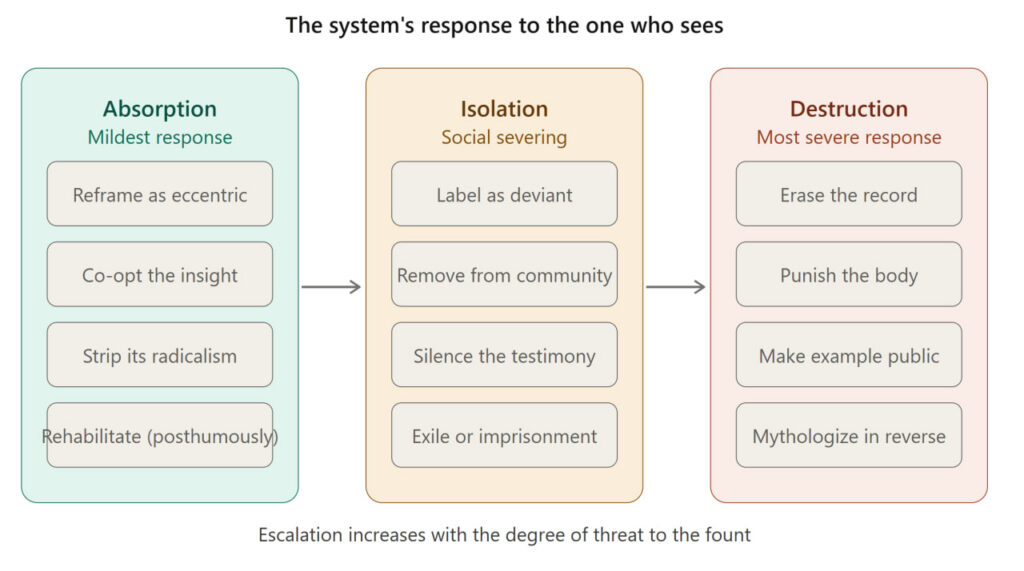
The stages are rarely sudden. They are incremental,, which is precisely what makes them so devastating.
First, the heretic is eccentric.
Tolerated at a distance.
Their questions are unusual but harmless, the system decides.
Then the questions become persistent.
Now they are inconvenient.
The social temperature drops. Invitations stop arriving.
Conversations grow careful.
Then the questions attract agreement, even whispered, even secret.
Now they are dangerous.
The system mobilizes more actively: reputation, livelihood, belonging.
Finally, if the questions survive all that, the system moves toward the body.
This is not paranoia. It is pattern.
Socrates drank the hemlock not because Athens lacked philosophical tolerance in the abstract, but because his questions had become a social fact powerful enough to threaten the polis’s self-image.
Galileo’s recantation was not about astronomy. It was about the church’s right to determine what counted as knowledge.
Al-Hallaj was executed not for mysticism, but for making that mysticism so direct, so personal, that it bypassed the institutional clergy entirely.
The system does not destroy the heretic because it is cruel. It destroys them because they are load-bearing.
Their continued existence [unbroken, unerased] is evidence that the frame can be seen through.
And that evidence must be managed.
| Figure | System | What they questioned | System’s response | Legacy |
|---|---|---|---|---|
| Socrates | Athenian democracy | Divine authority of the polis; moral consensus | Executed | Canonized as the father of philosophy |
| Hypatia of Alexandria | Early Christian order | Pagan knowledge, political authority of the church | Murdered by a mob | Symbol of reason against fanaticism |
| Galileo Galilei | Roman Catholic Inquisition | Geocentric cosmology; church as arbiter of truth | House arrest; forced recantation | Vindicated; apology by the church in 1992 |
| Ibn Rushd (Averroes) | Almohad Caliphate | Supremacy of reason over revelation | Exiled; works burned | Preserved by European scholasticism |
| Giordano Bruno | Roman Inquisition | Infinite universe; plurality of worlds | Burned at the stake | Icon of intellectual martyrdom |
| Rosa Luxemburg | Weimar proto-state | Capitalist order; party discipline | Assassinated | Recovered by the left; theorist of revolutionary democracy |
| Al-Hallaj | Abbasid Caliphate | Mystical union with God; institutional Islam | Tortured and executed | Revered as a Sufi saint |
The Peculiar Violence of Erasure
There are two kinds of destruction a system can visit on the one who sees.
The first is physical.
It is blunt, visible, and historically legible.
The second is more sophisticated and more complete: epistemic erasure.
The removal not of the body but of the testimony. The rewriting of the question as madness, heresy, or simple error.
The conversion of the heretic into a cautionary tale told in the language of the very system they questioned.
This is why so many heretics survive and are never recovered.
Their words exist. Their lives are documented. But the frame through which they are presented is the frame they spent their lives resisting.
Ibn Rushd’s works survived in Europe, preserved by the scholasticism he influenced, stripped of the radical autonomy of reason he had actually argued for.
Thomas More is remembered as a saint of the church that martyred him which is to say, the system absorbed his sacrifice and inverted his significance.
Hypatia is invoked as a symbol of reason against religion but her actual philosophical work is mostly lost, swallowed by the centuries of silence that followed her murder.
The archive is not neutral.
It is curated by those who outlast the heretic.
In The Divine Poison, the Ashen Tome rewrites itself literally.
Passages change under the eclipse.
What was recorded is no longer what is read.
This is not fantasy embellishment.
It is the metaphysical acceleration of something that happens in every system that survives long enough:
the record bends toward those who hold the quill.
The Inner Collapse
What is less documented, because it leaves no archive, is what happens inside the heretic.
The social cost is visible: exclusion, punishment, erasure. But the psychological cost is subtler and in some ways more devastating.
Erich Fromm, in Escape from Freedom, argued that freedom is genuinely terrifying, not as a political abstraction but as a lived experience.
To be released from the structure that organized meaning, belonging, and identity is not liberation.
It is, initially, dissolution.
The heretic does not simply lose their community.
They lose the cognitive scaffolding that made the world coherent.
Every piece of meaning they had built within the system becomes suspect.
Every relationship forged through shared belief is now contingent.
The self that was constituted by the frame — believer, member, initiate — begins to collapse.
What replaces it?
Sometimes: a new frame, adopted with equal totality.
The apostate who converts with the zeal of the convert.
The revolutionary who builds a new orthodoxy as rigid as the one they fled.
Sometimes: nothing stable at all.
A permanent liminality, living in the threshold between worlds.
Belonging to neither.
Seen as threat by both.
And sometimes, rarely, at great cost, something stranger and harder:
the person who holds the question without resolving it, who refuses both the comfort of the old frame and the consolation of a new one.
The Neophyte, in The Divine Poison, exists somewhere in this last category.
Wounded by clarity.
Sustained by neither certainty nor belonging.
Moving through a world where the suns bleed and the Veil shifts and where the refusal to pretend otherwise has cost everything except the refusal itself.
Systems Fear Them Most When They Are Quiet
There is a counterintuitive dynamic in the persecution of heretics.
The louder and more confrontational the heretic, the easier they are to manage.
They can be framed as agitators, destabilizers, threats to the common good.
The system has a script for this.
But the quiet heretic — the one who simply lives differently, who embodies the alternative without proselytizing it — is far more dangerous.
Their existence is not an argument.
It is a demonstration.
They show that the frame is not the only frame.
That the fount can be questioned and the world does not end.
That the thread can be pulled and one can survive… at least for a while.
This is why systems are so meticulous about not just silencing the heretic, but ensuring that the silence is complete.
Not merely preventing them from speaking, but preventing others from knowing they existed in the way they actually did.
The goal is not the death of the person.
It is the death of the possibility they represent.
Further Reading
• Hannah Arendt — The Origins of Totalitarianism
• Hannah Arendt — Eichmann in Jerusalem
• Erich Fromm — Escape from Freedom
• Umberto Eco — The Name of the Rose
• Albert Camus — The Rebel
• Baruch Spinoza — Theological-Political Treatise
• Michel Foucault — Discipline and Punish
• Elaine Pagels — The Gnostic Gospels
• Ibn Rushd (Averroes) — The Incoherence of the Incoherence
Contextual Threads
✴️ To understand how this framework manifests in fiction:
Threaded Shadow-Silk — the loom the heretic dismantles.
- Blossom of Deception — the architecture of what they see through..
The Devouring Comfort — why others cannot follow.
- The Quiet Rot — what belief costs when it cannot be questioned.