
Neophyte's Journal;The Poisoned Scribes
“We drank from the source,
Called it revelation.
In the fulness of time did we learn
The well had already been touched.
The living burnt through poisoned truths”
— Neophyte, Dawn Fragments
The . Name
POSTED Aug14 2026
The Doubted Did Not Leave
In The Last Heretic, we followed the one who pulled the thread — who saw the frame for what it was and paid for the seeing in exile, punishment, or erasure.
In The Willing Prisoner, we followed the one who saw the cage and chose, with full or partial knowledge, to remain inside it.
This post is about a third figure. Neither the one who left nor the one who merely stayed.
The one who stayed — and became useful to the system they once doubted.
The willing prisoner endures captivity.
This figure administers it.
They did not begin as believers.
They began, like most, as doubters — carrying a private fracture, a question quietly held.
But at some point, the silence became performance.
The performance became habit.
The habit became identity.
And then the poison took a name.
Theirs.
The Anatomy of Complicity
Complicity is rarely chosen in a single decisive moment. That is the story we prefer — the moment of moral failure, sharp and legible, where a person crosses a visible line.
The reality is more corrosive and more forgiving of self-deception.
It accumulates. In increments. In a series of choices so small that no single one feels decisive, until the aggregate is irreversible.
Hannah Arendt, writing about the trial of Adolf Eichmann, coined a phrase that disturbed precisely because of its precision: the banality of evil. Not monsters.
Not fanatics foaming with belief.
Bureaucrats. Administrators. People who signed the papers, coordinated the logistics, and went home to their families.
People who had, in many documented cases, privately registered discomfort at various points and then continued.
The discomfort did not stop the mechanism.
It only made those operating it feel more human while they did.
When the Mouth Outruns the Mind
Leon Festinger’s work on cognitive dissonance gives us the key mechanism.
The conventional reading of dissonance theory is that when our beliefs conflict with our actions, we change our actions to match our beliefs. But Festinger’s more disturbing finding was the inverse:
we often change our beliefs to match our actions.
Particularly when the actions have already been taken. When the cost of acknowledging the contradiction is higher than the cost of resolving it internally.
The person who performs devotion who repeats the doctrine, who enforces the rule, who punishes the dissenter, does not remain in internal conflict indefinitely.
The mind, that extraordinary instrument of self-preservation, does not sustain cognitive dissonance without resolution.
It resolves it by revising what it believes.
The mouth says the words enough times.
The mind eventually stops keeping a separate account.
This is not weakness. It is the mind operating exactly as it was designed to minimizing internal conflict, maintaining coherent narrative, protecting the self from the full weight of its own choices.
But the design, in this context, becomes a mechanism of moral disappearance.
The Five Stages of Complicity Arc
The journey from doubter to instrument does not look like a betrayal from the inside. It looks like a series of reasonable accommodations.
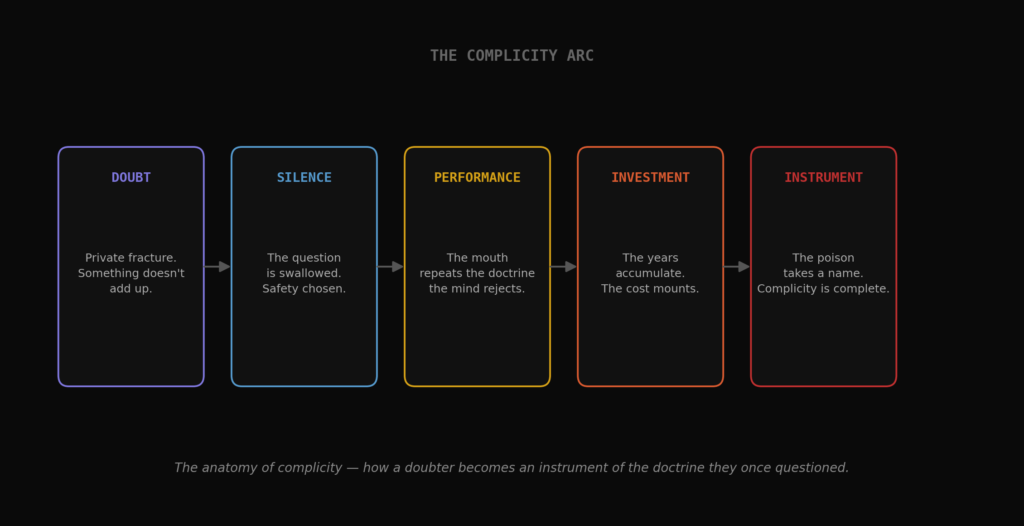
- Doubt is the starting point. Private. Unvoiced. The fracture in the frame that The Last Heretic also began with, but here, unlike there, it does not become a question spoken aloud.
- Silence is the first choice. Not ignorance. Choice.
The question is swallowed for reasons that feel legitimate: timing, safety, loyalty, the possibility of being wrong. Once swallowed, it does not dissolve.
It acidifies. - Performance is where the fork becomes permanent. The mouth begins producing what the system requires such as, affirmation, enforcement, testimony.
The body moves through the rituals of belief. The internal account and the external record begin to diverge. - Investment is what accumulates during performance. Every act of compliance is a brick in a structure the person is now living inside. Years.
Relationships built on the shared doctrine. Identity shaped by the role the system has given them. The cost of exit has now become existential rather than merely social. - Instrument is when the poison takes a name. The doubter is no longer a reluctant participant.
They are now an active node in the system,recruiting, enforcing, perpetuating. The private fracture has either healed over or been buried deep enough that it no longer interrupts the function.
Performance Rewrites Belief
The most counterintuitive element of this process is that by Stage 5, the person frequently believes. Not always. But often enough that the distinction between the original doubter and the eventual instrument feels, to them, like growth.
They call it conviction. They experienced it as conversion.
What happened was something more mechanical.
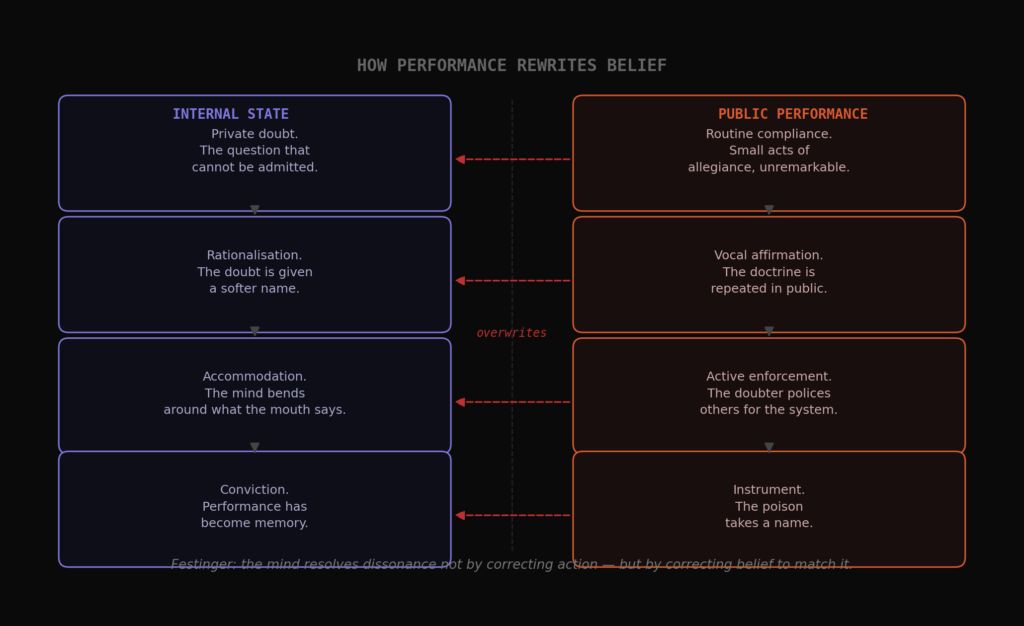
The feedback loop runs from external performance back into internal state.
Each time the body performs the doctrine, the mind narrows the gap between what is said and what is held.
Each act of enforcement reduces the psychological space in which the original doubt could survive.
This is why Festinger’s most important finding was not that we are hypocrites, but that we are self-correcting in the direction of our actions, not our principles.
The mind does not want the discomfort of knowing it is performing something it does not believe.
So it begins to believe it.
By the time the instrument is fully formed, the rewriting may be complete.
The doubt is not suppressed.
It has been metabolised.
The Historical Record
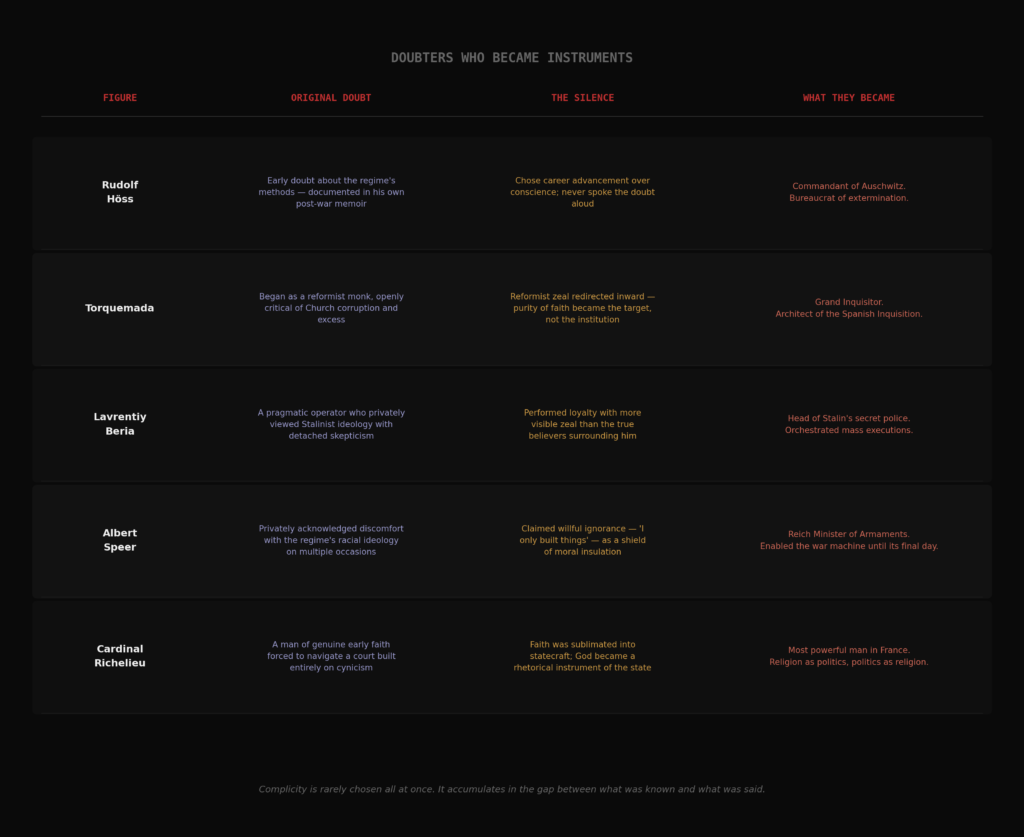
The archive of complicity is long. What follows are not its most infamous entries (those are well documented elsewhere) but five figures whose specific arc maps the movement from private doubt to systemic instrument with particular clarity.
What the table does not show — because no table can — is the precise moment the arc became irreversible.
History does not record the internal conversation.
It records the signature on the document, the order given, the apparatus built.
The doubt that preceded it is usually recovered only in memoir, in private correspondence, in the testimony of those who knew them before the performance calcified into conviction.
The System’s Investment in the Convert
There is a reason systems favour the converted doubter over the lifelong believer.
The lifelong believer’s faith is ambient.
They were born into the doctrine; they carry it easily, without friction, without the particular intensity of someone who arrived at it across a cost.
The converted doubter carries something sharper: the need to justify the conversion.
Every year spent as an instrument of the system is a year that must be made meaningful in retrospect.
The alternative (that the years were spent in complicity with something the person never truly believed) is a psychological burden most will do almost anything to avoid.
The system knows this, even when it does not articulate it.
It knows that the person who came from doubt and stayed makes its most reliable instrument.
Not because they believe more deeply.
Because they need to.
In The Divine Poison, this dynamic runs through the Hierarchs’ inner structure.
The most zealous administrators of the Veil are not those who were born to its doctrine.
They are those who came to it across a rupture, who had, at some point, seen the frame.
Whose continued service inside it is therefore not merely professional but existential.
They enforce the Veil not only to keep others blind.
But to justify the years in which they chose, again and again, not to look.
The Poison Costs the Carrier
What tends to be overlooked in the study of complicity is the damage done to the instrument itself.
Much of the literature concerns the victims of complicit systems.
This is correct and necessary.
But the anatomy of the doubter-turned-instrument also includes a particular internal cost that rarely surfaces in the historical record.
The doubt does not always die.
For some, it persists below the performance, below the investment, below the conviction, a small persistent signal that something was known and not acted on.
Not loud enough to interrupt function.
But present.
Surfacing in the hours between sleep and waking.
In the language of what Freud called the return of the repressed.
This is why so many memoirs of former instruments, written after the system collapses, written in old age, written under the specific pressure of a historical reckoning, describe not guilt for what they believed, but grief for what they knew.
Not: I thought this was right and was wrong.
But: I knew and spoke the words anyway.
That distinction is the specific wound the poison leaves in the one who carries it.
The heretic’s wound is visible. External. The cost of having spoken.
The instrument’s wound is internal.
The cost of having known and chosen the performance instead.
Further Reading
• Hannah Arendt — Eichmann in Jerusalem: A Report on the Banality of Evil
• Leon Festinger — A Theory of Cognitive Dissonance
• James Waller — Becoming Evil: How Ordinary People Commit Genocide and Mass Killing
• Christopher Browning — Ordinary Men: Reserve Police Battalion 101 and the Final Solution in Poland
• Robert Cialdini — Influence: The Psychology of Persuasion
• Erving Goffman — The Presentation of Self in Everyday Life
• Primo Levi — The Drowned and the Saved
• Adam Cohen — Imbeciles (on complicity within institutions)
• Václav Havel — The Power of the Powerless
Contextual Threads
✴️ To understand how this framework manifests in fiction:
- Threaded Shadow-Silk — the system that recruits the instrument without announcing itself.
- The Last Heretic — the one who took the doubt in the other direction.
- The Willing Prisoner — the one who stayed without becoming useful to the frame.
- Blossom of Deception — the architecture the instrument is built to maintain.
- The Quiet Rot — what happens to belief when it is never permitted to be questioned.