Neophyte's Journal;The Poisoned Scribes
“Bars were built willingly,
A thralling facade called home.
The doors stood open all along
Eyes refrained from looking outside
For what stood beyond the frame was feared”
— Neophyte, Dusk Fragments
The Willing Willing Prisoner
POSTED July 1, 2026
The Cage That Asks for Nothing
Most discussions of captivity assume a guard.
A wall.
A visible mechanism of force holding the prisoner in place.
But the most durable cages in human history have rarely needed one.
In Threaded Shadow-Silk, we traced the six forces that weave coherence out of fate, forge, fervor, faith, fount, and frame — a system so complete it no longer requires enforcement.
In The Last Heretic, we followed the individual who tears that fabric and pays for it in exile, erasure, or worse.
This post is about someone else entirely.
Not the one who is punished for leaving.
The one who could leave and doesn’t.
Not because they are deceived.
Because they know, and they stay.
Knowledge Without Departure
There is a peculiar psychological state that sits beneath most discussions of belief and ideology: the condition of lucid captivity.
The prisoner who has, at some level, already seen the frame for what it is and chooses, again and again, not to walk through the open door.
This is distinct from the unaware believer.
The unaware believer cannot leave because they do not see the bars.
The willing prisoner sees the bars clearly.
And finds them, on balance, preferable to the alternative.
Festinger’s work on cognitive dissonance gives us the mechanics: once a costly commitment has been made — time, identity, relationships, years of devotion — the mind does not simply abandon it when contradictions surface.
It often intensifies belief to justify the cost already paid.
The greater the sacrifice, the harder the system works to justify having made it.
This is not stupidity. It is economics of the self.
To leave is to admit the years were wasted.
To stay is to keep the ledger balanced, even at the price of freedom.
Architecture of the Willing Cage
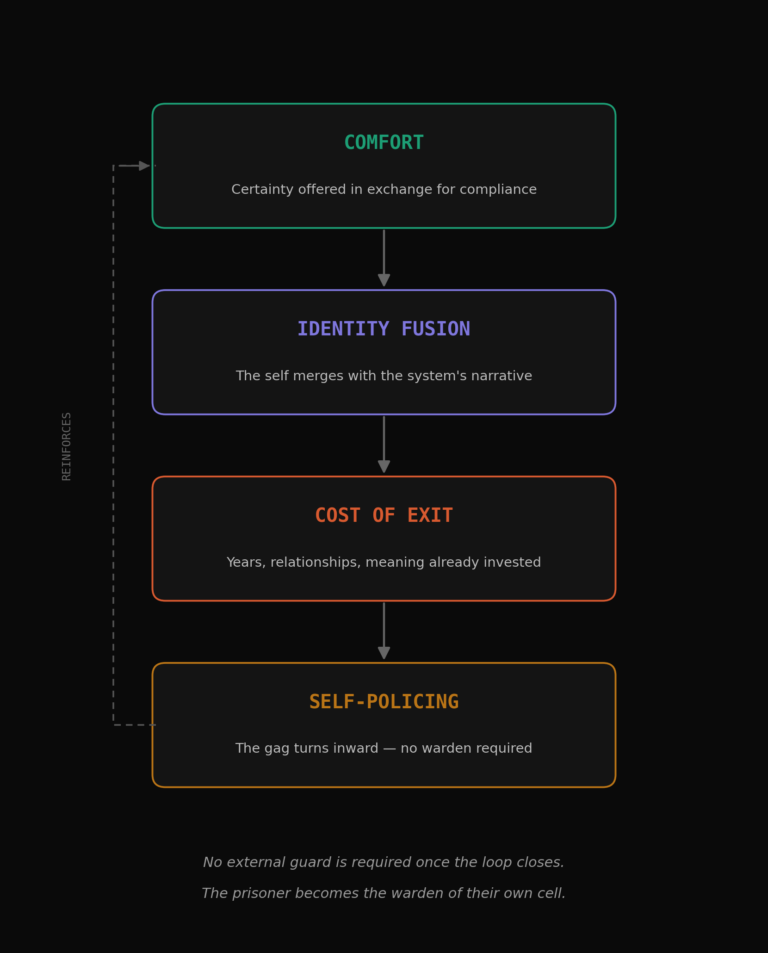
The captivity is not built in a single act. It accumulates in four overlapping stages and unlike a system relying on external enforcement,
this one requires no warden once the architecture is complete.
| Stage | Mechanism | What it produces |
| Comfort | Certainty offered in exchange for compliance | Relief from the burden of ambiguity |
| Identity fusion | The self merges with the system’s narrative | An attack on the doctrine feels like an attack on the body |
| Cost of exit | Years, relationships, and meaning invested | Leaving now means retroactively losing the self that stayed |
| Self-policing | The gag turns inward | No external enforcement needed — the prisoner watches themselves |
Each stage reinforces the one before it.
By the time self-policing emerges, the system has achieved something more efficient than any guard: a prisoner who experiences their own confinement as choice, even virtue.
This is the architecture The Devouring Comfort described from the system’s side — sanctified falsehood, useful because it stabilizes.
The willing prisoner is what that architecture produces in the individual:
someone for whom comfort and captivity have become indistinguishable.
Scaled Stockholm & Outsourced Conscience
The clinical literature on what is colloquially called Stockholm Syndrome offers an uncomfortably precise model, even outside hostage situations.
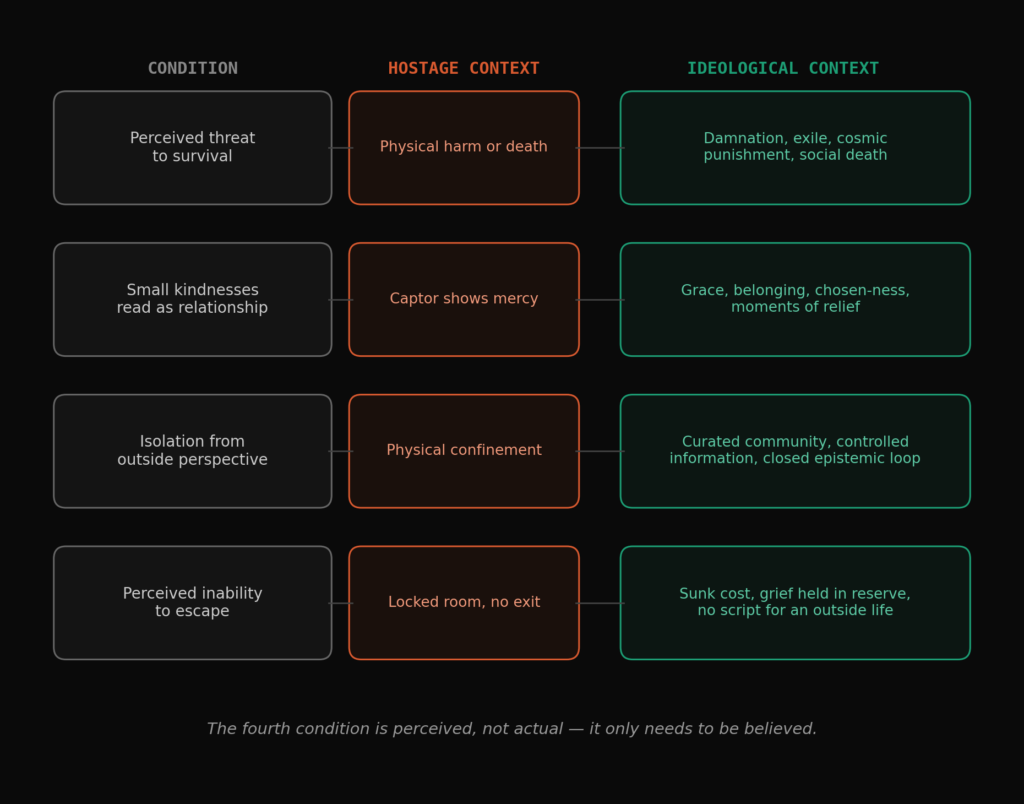
Captives who develop positive feelings toward captors typically share specific conditions: a perceived threat to survival, small kindnesses interpreted as relationship, isolation from outside perspectives, and a perceived inability to escape.
Notice that the fourth condition is perceived. Not actual.
Many who remain in coercive systems — religious, political, relational, ideological — are not physically restrained.
They are restrained by the conviction that escape is impossible, unthinkable, or more costly than submission.
This perception does not need to be accurate to be effective.
It only needs to be believed.
In The Divine Poison, those bound to the Hierarchs are rarely shackled.
The chains are theological, social, internal.
The Veil makes captivity feel cosmic rather than constructed and a captivity that feels cosmic does not feel like a choice at all.
Erich Fromm’s Escape from Freedom remains the sharpest articulation of why people surrender autonomy willingly.
Freedom, Fromm argued, is not simply desired. It is also, simultaneously, dreaded because freedom carries the full weight of moral responsibility.
The willing prisoner trades freedom for relief from that weight.
If the system decides, the individual does not have to.
If doctrine assigns guilt, conscience does not have to negotiate it alone.
If salvation is conditional on obedience, then the terrifying openness of an unscripted life closes neatly into a single, legible task: comply.
This is not weakness in any simple sense. It is a rational transaction under specific psychological conditions, certainty purchased at the price of agency.
The tragedy is that the purchase, once made, becomes nearly impossible to reverse.
Each day inside the system is a day further invested in its truth.
The sunk cost is not financial. It is existential.
Why the Door Stays Open
What makes the willing prisoner distinct from both the unaware believer and the heretic is this: they know the door is open.
They have, at some point, stood close enough to see daylight.
And still they step back.
Three reasons recur across testimonies of those who eventually did leave high-control systems, looking back at the years they stayed despite knowing:
Fear of the unscripted.
Outside the frame, there is no fount to validate meaning, no fervor to carry the weight of belief.
The terror is not of punishment.
It is of formlessness.
Loyalty to the self that stayed.
To leave is to implicitly judge every previous year as a mistake.
Many will defend a system not because they still believe it, but because abandoning it would mean abandoning who they were while believing it.
Grief held in reserve.
Leaving is not an event. It is the beginning of a mourning process, for community, identity, certainty, and time that many sense intuitively and choose, consciously or not, to postpone indefinitely.
The door does not need a lock. Grief is enough of a deterrent.
The Quiet Difference Between Captivity and Choice
There is a question this post cannot resolve, and should not pretend to: at what point does a willing prisoner stop being a prisoner at all?
If someone, with full clarity, decides that the comfort of the frame outweighs the cost of leaving it, is that captivity, or is that simply a value judgment we happen to disagree with?
The honest answer is that the line is not fixed.
It moves with the degree of coercion embedded in the system, the genuine availability of alternatives, and the psychological cost imposed on those who try to leave.
What can be said clearly is this: a system that requires its members to believe escape is impossible, even when it isn’t, has crossed from offering meaning into manufacturing captivity.
The willing prisoner is not always wrong to stay.
But the system that needs them to believe they cannot leave is never innocent.
Further Reading
• Erich Fromm — Escape from Freedom
• Leon Festinger — A Theory of Cognitive Dissonance
• Patty Hearst / Frank Ochberg — clinical literature on traumatic bonding
• Janja Lalich — Bounded Choice: True Believers and Charismatic Cults
• Steven Hassan — Combating Cult Mind Control
• Judith Herman — Trauma and Recovery
• Erving Goffman — Asylums
Contextual Threads
✴️ To understand how this framework manifests in fiction:
- Threaded Shadow-Silk — the loom that makes the cage feel inevitable.
- The Devouring Comfort — why the lie remains preferable to truth.
- The Last Heretic — the one who walks through the open door, and what it costs them.
- The Quiet Rot — what belief demands once it cannot be questioned.